Back to Resources — Light & EMF
Daily Use Since 2019 · Interviewed the Founder
VivaRays
Circadian light harmonizing glasses — why I wear three different lenses every single day, and what changed when I started.
Circadian light harmonizing glasses — why I wear three different lenses every single day, and what changed when I started.
Fluorescent lights and LEDs dominate modern indoor environments — offices, homes, phones, televisions, computer screens. The problem is not simply that they emit blue light. The problem is that their spectral ratio is wrong: the blue end of the spectrum is radically overrepresented relative to what our biology expects, and most of them flicker at a frequency our eyes cannot consciously detect but our nervous systems register.
Your body interprets this as an environmental signal. Persistent bright-spectrum, flickering artificial light tells your hypothalamus that it is midday — that you are in full sun, that you should be alert, that now is not the time to wind down. Your melatonin suppression is not a sleep problem. It is a light problem.
You cannot swap out every light bulb everywhere you go. What you can do is manage what actually reaches your eyes — and that is exactly what VivaRays is built for.
Most LED bulbs — including the ones in your home, your office, and the screens you use every day — flicker. Not at a rate you can see with the naked eye. At a rate your camera can capture.
When you replay the video, you will see the flicker. A rapid, rhythmic pulsing that is invisible in real time. That pulse is present in your environment continuously — and your nervous system is processing it, even when your conscious mind is not. It is a low-grade stressor running in the background of your day.
This is not a performance trick. It is a demonstration of what photobiological researchers have documented: that flicker and spectral imbalance in artificial light environments contribute to eye strain, headaches, fatigue, and circadian rhythm disruption. Managing light at the level of the eye is one of the most practical interventions available.
Most blue-light glasses get this wrong. A single amber or yellow lens used all day blocks more blue light than your daytime biology needs blocked — which confuses your circadian clock in a different direction. VivaRays was designed around the full arc of natural light across a day: bright and blue-rich in the morning, warm and amber in the evening, near-zero blue at night.
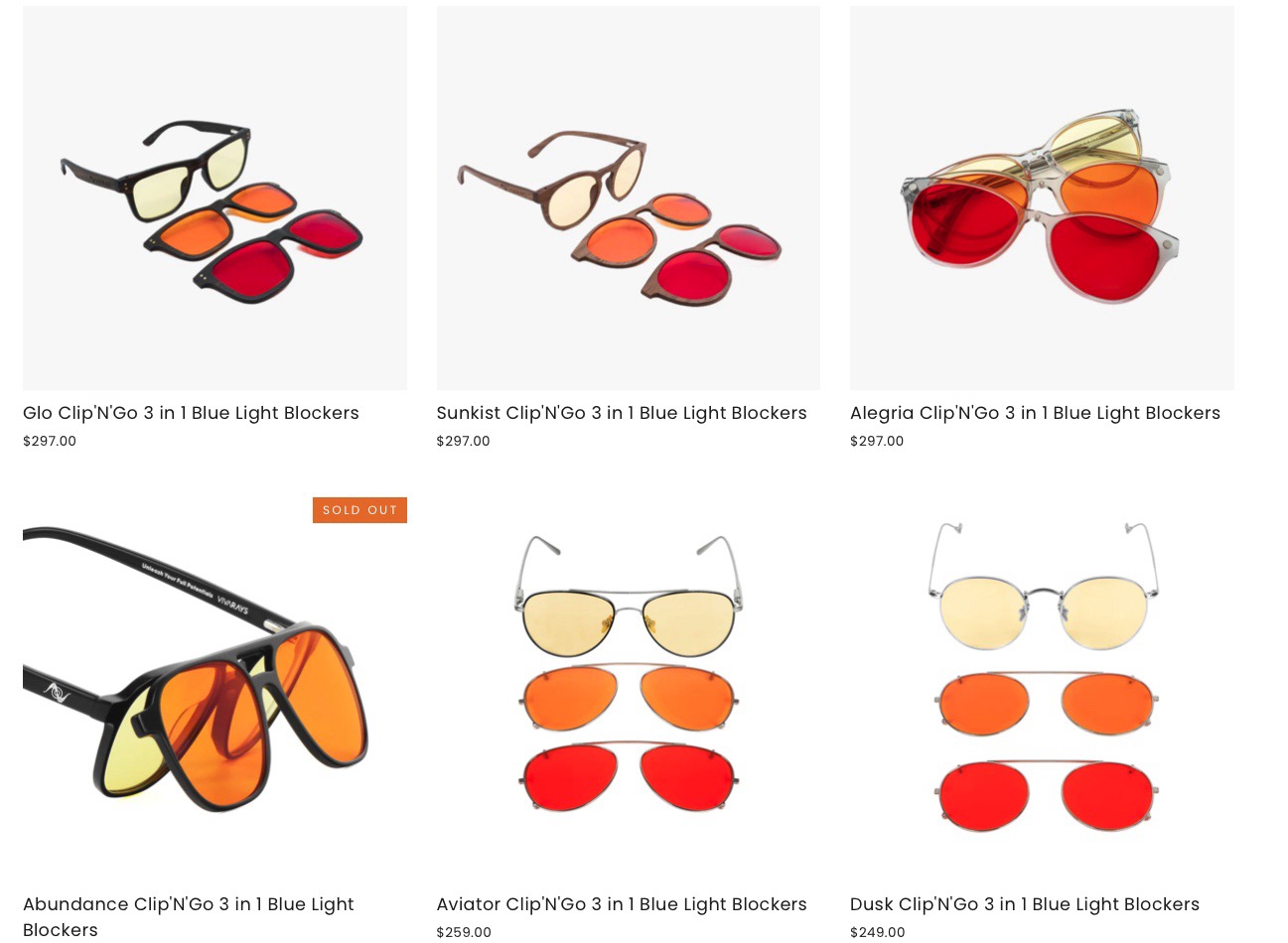
There are three lens types in the system, each calibrated for a specific phase of your day.
The DayGo'z lens does not block blue light wholesale. It harmonizes it — filtering the most stressful frequencies while preserving the daytime light signal your biology needs to stay alert and regulate your cortisol-melatonin rhythm. This is the distinction that matters. A lens that is too dark during the day does harm of its own. These take the edge off eye strain, reduce headaches from screen use, and reduce the fatigue that builds across a long day at a monitor — without telling your body it is evening at 10 in the morning. Safe for driving.
Put the Eve'z on when the sun goes down. The amber tint mimics the spectral profile of firelight — the light source humans evolved with after dark for most of our existence. It blocks all blue light and unwanted green while allowing some green through, beginning the physiological transition toward rest. This is the signal to your hypothalamus that the day is ending. Melatonin production starts to rise. The nervous system begins shifting toward parasympathetic. You start to actually feel it. Safe for driving.
The Sleeper'z blocks all blue and all green light — only warm red-spectrum light passes through. This is the most aggressive setting and the most dramatic in its effect. Put these on an hour before bed and your body begins producing melatonin in earnest. The sedating effect is real and noticeable. These will knock you down. If you have ever struggled to feel genuinely tired at bedtime despite being exhausted, this is one of the most underrated interventions in sleep health. Not for driving.
Source: VivaRays lens comparison. All three lenses are available in non-prescription, prescription, and reader formats.
Most eyeglass frames and lenses are manufactured from petroleum-derived plastics. VivaRays uses a non-petroleum-derived resin sourced from Italy — a harder, more optically precise material that is also a cleaner choice from a materials standpoint. It is a detail that most lens companies do not address, and it reflects a brand philosophy that extends the "what are you putting near your body" question from product formulations to product construction.
This is one of the reasons I chose VivaRays over other blue-light blocking options in the category — and it is the kind of detail you only surface by going deeper than the marketing.
I started using VivaRays in 2019. What I can tell you after years of daily use is that the nighttime lens effect is not placebo. When I put the red lenses on an hour before bed, something shifts — a real, physiological wind-down that I have not been able to replicate any other way. The evening amber lens has become as automatic as turning off the overhead lights after dinner.
I have also interviewed the founder on my podcast — that conversation is where I learned the depth of the design philosophy, particularly the daytime lens calibration, which is where most competitors miss. The language they use is "harmonizing" rather than blocking, and when you understand the circadian biology behind it, that distinction is not marketing. It is the whole point. You can watch the full interview below.
The VivaRays Clip'N'Go system is worth looking at for anyone who already wears prescription glasses — it clips over your existing frames and gives you all three lenses without needing separate pairs.
Anyone who works at screens, experiences disrupted sleep, gets eye strain or headaches from indoor lighting, or notices they feel wired and alert when they should be winding down. This is most people living in a modern built environment.
The Clip'N'Go 3-in-1 is the most practical entry point — one frame, all three lenses, designed to clip onto their own base frames. If you want standalone glasses, each lens type is also available in their full frame collections.
Daytime lens at the computer during the day. Evening amber at sunset. Red nighttime lens an hour before bed. After two or three weeks of consistent use, the shift in how you feel at bedtime is noticeable enough that you will not want to skip it.
Use code JFBIOWELLNESS at checkout for 15% off your order, applied automatically when you shop through my link below. The Clip'N'Go 3-in-1 is where I would start — it covers all three phases of the day and works on any of their base frames.
Affiliate link — I may earn a commission at no additional cost to you. Affiliate relationships never determine what I recommend — VivaRays passed through The Low-Tox Frenchy Standard before making this page.